Agricultural Equipment Lease Process

Leasing in agriculture is often discussed as an alternative to traditional financing. For lenders, it is mainly a structuring tool. Capital partners like Agri-Access often support these transactions, helping expand capacity and flexibility.
Leasing is one financing option lenders use to structure agricultural transactions more effectively.
Agricultural equipment, farm storage building and farm facility leases help align financing with asset life. They also preserve existing loan structures and support complex projects without disrupting borrower relationships.
This step-by-step walkthrough shows how people review and implement a typical farm leasing process. It starts with the first request and ends with final ownership.
Inside an Agricultural Lease Transaction
HOW LEASING IS STRUCTURED FOR AG LENDERS
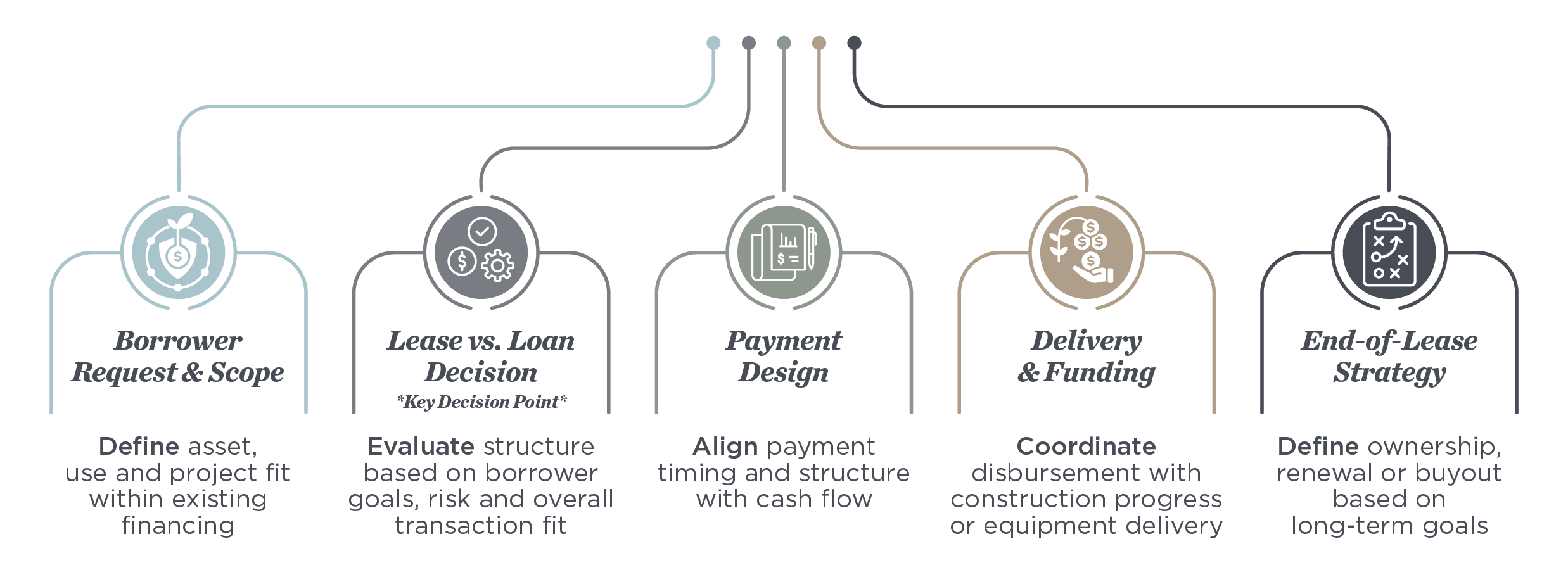
The agricultural leasing process follows a clear structure. This visual shows how someone structures and implements a typical transaction.
Each step plays a role in aligning financing with borrower needs and lender strategy. The sections below walk through each stage in more detail.
Step 1: Borrower request and project scope
The process begins with a borrower need tied to equipment acquisition or farm storage/facility expansion.
From a lender perspective, this step focuses on:
- Defining the asset and overall project scope
- Understanding how the asset will be used in the operation
- Evaluating how the project fits within existing financing
This stage sets the foundation for how the lease will be structured. This is a common starting point in the farm equipment leasing process and helps define how the transaction will move forward.
Step 2: Lease vs. loan structure evaluation
At this stage, lenders determine whether leasing is the right structure compared to a traditional loan. This is a key step in how agricultural leasing works, especially when evaluating lease vs loan agriculture decisions.
This is especially relevant when comparing real estate and farm equipment leasing within a broader financing strategy.
Consider leasing when:
- The borrower wants to preserve an existing real estate loan
- Farm storage buildings or farm facilities are added without refinancing land
- The transaction requires flexible structuring
- Participation may support a larger or more complex transaction
At this point, Agri-Access may work with lenders to review structure options. These include participation and lease design. This helps support larger or more complex transactions.
This decision is less about the asset itself. It focuses more on how the financing fits within the broader relationship and portfolio.
Step 3: Payment design aligned to agricultural cash flow
Once leasing is selected, payment structures are designed to match agricultural income patterns.
This may include:
- Seasonal or harvest-based payment schedules
- Step-up or step-down payment structures
- Custom timing aligned with production cycles
Payment structures are developed in coordination with Agri-Access to reflect both borrower cash flow and transaction structure.
The goal is to create a structure that supports repayment while reflecting how and when the business generates revenue.
Step 4: Construction or asset delivery and disbursement
This step varies depending on the type of project.
For facility projects, disbursement may occur over time as construction progresses.
For equipment transactions, this step includes:
- Asset delivery and acceptance
- Vendor coordination
- Funding aligned with delivery timelines
Agri-Access supports funding alongside the lender to align with construction timelines or equipment delivery.
Clear coordination between lender, borrower and vendor keeps the transaction on track.
Step 5: End-of-lease ownership options
At the end of the lease term, several options may be available depending on how the agreement is structured.
These may include:
- Ownership transfer
- Renewal or restructuring of the lease
- Buyout aligned with the asset’s remaining value
Lenders typically define these options early in the process and align them with borrower goals and overall strategy.
How leasing fits into ag lending strategy
Leasing expands how lenders structure and deliver financing, especially when paired with participation and other agricultural equipment financing options.
Through partnerships with Agri-Access, lenders can:
- Offer leasing solutions without building internal infrastructure
- Support larger transactions through participation structures
- Maintain borrower relationships while accessing additional capital
- Scale agricultural lending programs without added operational complexity
Leasing does not replace traditional lending. It adds flexibility in how teams structure and deliver transactions.
Explore leasing solutions
Leasing structures vary based on asset type, transaction size and eligibility.
Start the conversation
Understanding how a lease is structured is only the first step. The next step is applying it within your lending strategy.
Your Relationship Manager can help evaluate how leasing fits within your portfolio strategy and current opportunities.
Connect with a Relationship Manager